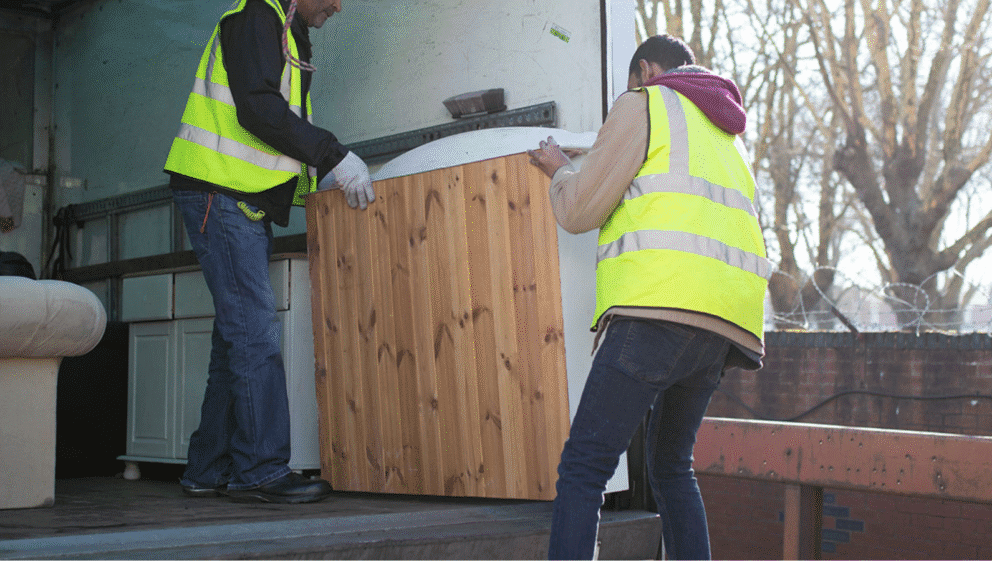
Across the UK, reuse charities play a vital role in tackling poverty, reducing waste, and supporting households facing furniture poverty. Every year, thousands of families rely on donated furniture and white goods to rebuild their lives after a crisis. Our charity members are based within our communities, providing a variety of services, including welfare support for furniture and white goods, which rely on generating income to cover the associated costs.
How do charities cover the costs? Thanks to the donation of high-quality, high-value items, our members can sell these items in their retail shops and via online platforms, which helps generate much-needed income for the charity and creates meaningful employment opportunities for local people.
At Reuse Network, we are seeing a rise in corporate donors imposing restrictions on how donated goods can be used. Common clauses include “must not be resold,” “free to end user only,” or requirements to remove branding entirely. These conditions are usually well-intentioned – companies want to protect brand identity, create social value, and ensure donations are seen as unequivocally charitable rather than commercial. However, the conditions attached to these donations are placing increasing pressure on charities. On the ground, these restrictions carry costs, which are often invisible to donors and the broader public.
Hannah Jordan, Chief Operations Officer at Reuse Network, delves into the real cost of reusing household items and the importance of resale for charities working on the frontline.
The real cost of giving furniture away for free
Reuse charities do not operate on goodwill alone. They are logistics-heavy organisations with overheads that closely mirror those of the businesses they work with: staffing, transport, warehousing, insurance, utilities, compliance, and administration.
One UK reuse charity recently calculated the average cost of providing furniture free of charge. The findings were stark:
- £500 per household to provide support before furniture is even included, e.g. staff, storage, fuel, etc
- £700 per household minimum when furniture and white goods are included
These figures account for:
- Multiple collections needed per referral (around ten, as many collections yield no usable items)
- Storage and grading of stock
- Staff and volunteer coordination
- The reality that most households need four or five items, while most donors offer just one
Volunteers help keep costs down, but even volunteer programmes have a price – estimated at around £4 per hour once training, support, and management are included. Many furniture projects are also Real Living Wage employers and face the same rising pressures as their corporate partners: increased National Insurance, fuel, utilities, and insurance costs.
When donations cannot be resold, charities lose a critical income stream that normally helps offset these unavoidable expenses.
Why resale matters
Resale is not a deviation from charitable purpose; it is often what makes free provision possible.
When charities can sell a proportion of donated goods – in particular, high-quality white goods – they can provide:
- Free provision for people in acute need
- Very low-cost items for those on limited incomes
- Training and employment pathways
- Long-term organisational sustainability
Restrictions on resale remove the ability to offer these services. Even where large volumes are offered, charities are increasingly being asked to operate at a “£0 value” while absorbing all associated costs.
As one sector leader put it, charities often accept these terms not because they are ideal, but because the alternative is exclusion altogether.
Branding, perception, and unintended consequences
Some agreements from large commercial donors also require full de-branding of donated items. While understandable from a brand-protection perspective, this can further depress resale value. Most customers cannot distinguish between “good” and “excellent” quality without a recognised brand name. The result is lower income for charities – even when the product is premium.
At the same time, highly branded redistribution initiatives have begun to “hoover up” large volumes of previously available donated goods. While these models deliver visible impact, they also divert stock away from established reuse organisations – often under strict conditions that prohibit resale.
This has knock-on effects:
- Increased competition for limited free stock
- Growth of informal or black-market resale, which restrictions aim to prevent
- Reduced financial resilience among frontline reuse providers
A growing disconnect
Across the sector, there is a growing sense of disconnect between corporate ambition and operational reality. The expectation that charities can absorb all costs related to reusing surplus or unwanted stock indefinitely – while delivering environmental, social, and reputational benefits for others – is not sustainable.
This is not an argument against free provision. Reuse charities will always prioritise getting essential items to people who need them most, and many would never walk away from an opportunity to distribute goods free of charge, even if only to tenants within their own housing stock. But “free to the recipient” does not mean free to deliver.
Towards more honest partnerships
The way forward is not to abandon restrictions entirely, but to have more honest conversations about cost recovery and value. In some cases, free-to-recipient models can work – where volumes, quality, and logistics align, and where transport or handling costs are covered. As part of a balanced portfolio, they can be effective.
As a default model, however, they risk shrinking reuse capacity, undermining exactly the environmental and social outcomes donors want to achieve.
If reuse charities are to remain practical partners in tackling waste and inequality, restrictions on donations must come with recognition of the true cost of making reuse happen.
Because when charities are forced to operate on reduced income, it isn’t just the organisations that suffer – it’s the people and communities they exist to serve.
How you can help
Reuse charities in our network need your donations of gently used household and electrical items to help them continue supporting local people. If you’re interested in donating, you can find your local reuse charity here.
If you work for a commercial organisation and would like to discuss how you can create positive impact through your surplus stock, please email info@reuse-network.org.uk or call the Reuse Network office on 0800 085 8339.